
Why Your 120 Franchise Locations Are Running 120 Different Brands (And How to Fix It)
by Steph Blackwell
Imagine:
One morning, a franchisee is worried because leads are slow. He opens ChatGPT, asks for “a killer promo to get more business,” and in 30 seconds, he has ad copy that sounds confident, uses a couple of “proven” claims, and throws in an urgent offer he’s seen in another industry.
He then drops it all into a Canva template he found while scrolling Facebook. The colors are close enough; he didn’t change the font, and the logo is slightly wonky. He decides to launch the ad, and it goes live by lunch.
Multiply this by 120 locations, each one approving and using marketing that is close enough. This is the pitfall of the AI era: rapid, ongoing, and decentralized decision-making without a way to contain the damage, let alone prevent it.
Franchises have always lived in the middle of two competing truths:
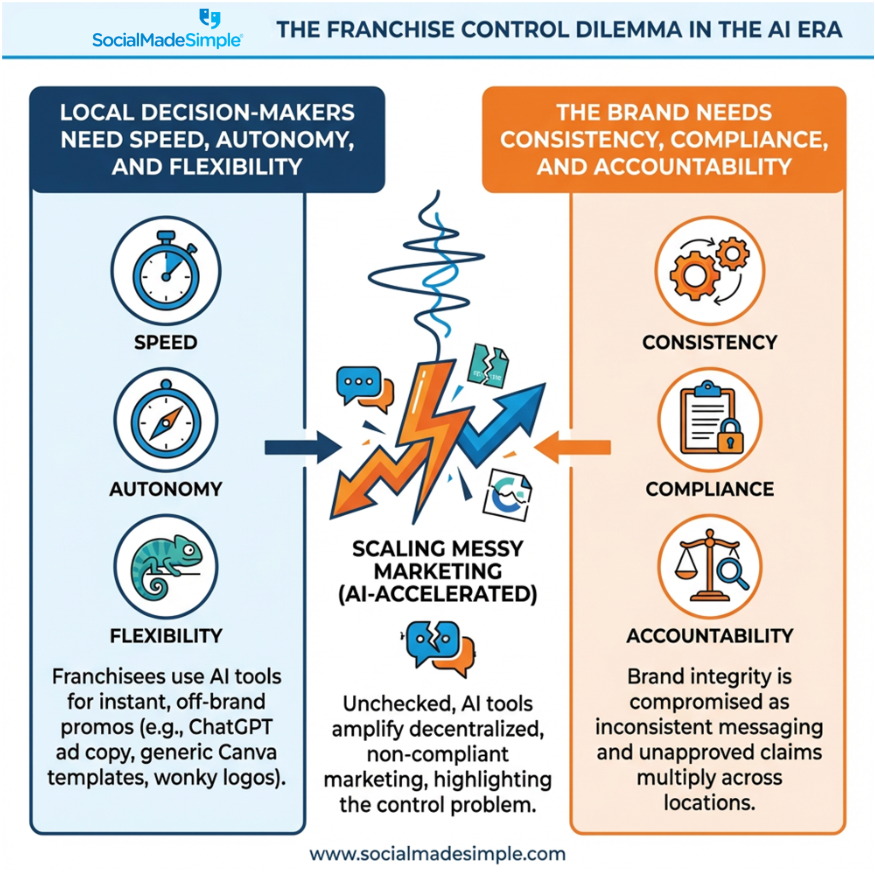
- Local decision-makers need speed, autonomy, and flexibility
- The brand needs consistency, compliance, and accountability
Most brands have addressed this tension through sheer effort: extensive training, convoluted guidelines, and the hope that franchisees will use good judgment. AI didn’t cause this tension; it just made the weak spots obvious by putting marketing tools in franchisees’ hands for next to nothing. When the output is free, inconsistency becomes unlimited.
The cost of when local marketing becomes a free-for-all
Brand consistency is more than “vibes.” When individual franchisees make high-level marketing decisions, it hurts everyone’s bottom line.
1) Wasted money
If every location is running its own advertising experiments, you’re spending real dollars to rediscover the same lessons, over and over, business to business.
2) Noncompliance risk
When one location makes a claim that crosses the line, the consequences aren’t isolated to just them. It’s HQ’s problem, too. If you’re in the health, wellness, financial, or home services industries, or any industry that provides safety and wellness services, “creative freedom” quickly becomes a legal gray zone.
3) Loss of local brand trust
Customers don’t think in org charts, they just see the brand. If one location looks sketchy, and another looks polished, the customer won’t assume that one franchisee is messing up. If there is an inconsistency across locations, where will they take their business? Right to your competitors.
4) Weakening your ability to recruit new owners
An ideal potential franchisee pays attention to the relationship between headquarters and locations. Sloppy, chaotic marketing is a red flag for a lack of standards, support, and operational maturity. Not a company that someone will want to invest in.
5) Can’t answer basic questions
“What offers are running right now?”
“What creative is being used?”
“Which message is actually working?”
“What is and isn’t selling?”
If you can’t answer those centrally, you don’t have marketing, you have noise.
AI scales the mess you’re already facing
AI is great at producing something. But it’s not great at protecting your brand, especially when dozens to hundreds of franchisees are prompting AI based on their own needs, without seeing the company’s bigger picture.
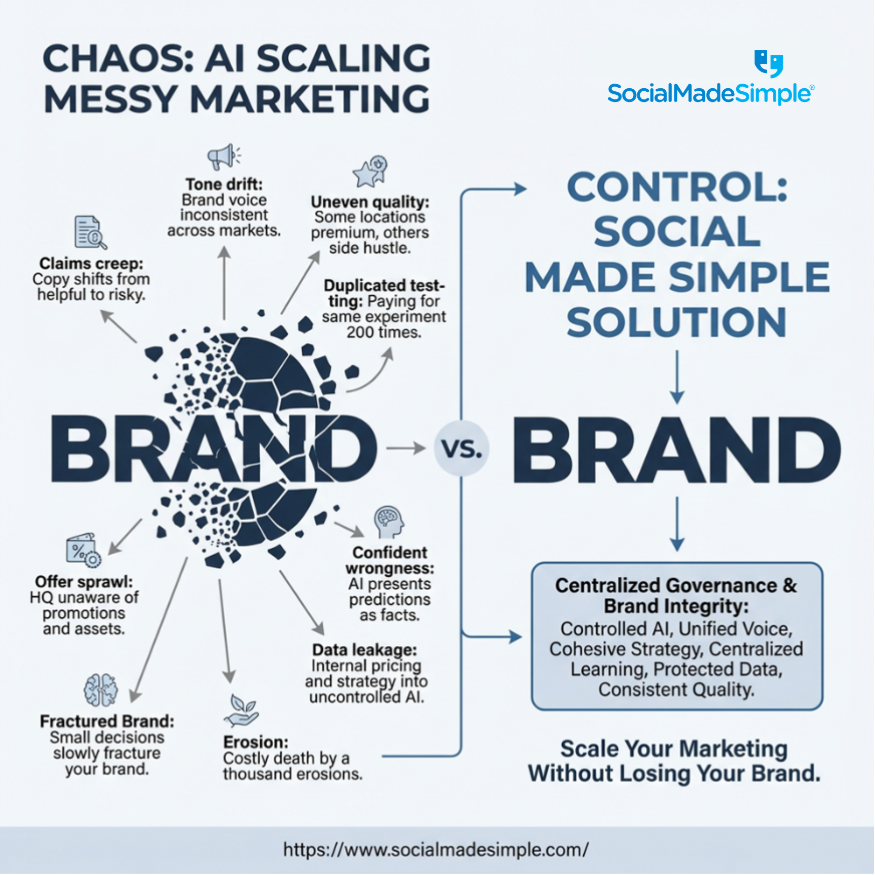
AI, then, isn’t the root cause of why your marketing is failing. The failure stems from thousands of small decisions that slowly fracture your brand.
- Claims creep. Copy shifts from helpful and novel to risky, especially in regulated industries such as real estate and healthcare.
- Tone drift. The brand voice becomes optional and inconsistent across markets. One location is a neighborhood, family-friendly, mom-and-pop business. Another is professional and efficient. It’s a gamble which one any given customer will experience.
- Uneven quality. Some locations look premium. Others look like a side hustle.
- Duplicated testing. You pay for the same experiment 200 times and learn nothing centrally.
- Offer sprawl. HQ has no idea who is running what promotions, where, and with which assets.
- Confident wrongness. AI makes predictions and presents them like they’re facts.
- Data leakage. Individuals input internal pricing, promos, or strategy into AI tools you can’t control.
These fractures aren’t spotted by franchisors because this problem isn’t a blazing fire, it’s erosion. Death by a thousand erosions is costly.
Franchises are uniquely vulnerable to AI mess-making
AI and franchise business thrive in opposite environments. AI works best with open-ended, unstructured parameters, while the point of the franchise model is to rinse and repeat what works:
- Brand standards
- Regulated claims
- Offer governance
- Pricing boundaries
- Customer experience consistency
- Clear positioning across locations
When AI is dropped into your business without guardrails, it becomes the silent killer of multi-location growth and success: inconsistency scaled.
This is how local and individual optimization causes widespread damage to your business.
For example,
- Location A is running a discount offer that HQ neither approved nor would ever approve, and it does work in the short term. But now the market expects it
- Location B uses AI-written copy that makes an ambiguous claim. It wasn’t flagged until a customer complained, landing HQ in a tense spot
- Location C hires a local marketer who makes “small tweaks” to the ad strategy that slowly detach the look and voice from HQ’s brand, which confuses a potential customer who doesn’t know what this location offers
- Location D runs ads with a unique audience targeting strategy. Results are fine, but because there’s no way for this location to share the insights, HQ can’t learn from it, and therefore, can’t implement it widely
Each location thinks it’s being resourceful, but HQ pays the price in the form of inconsistency, duplicate spend, and mistrust.
Take control and treat marketing like infrastructure, not output
Most marketing departments view marketing as developing tools and templates and using them in their strategy.
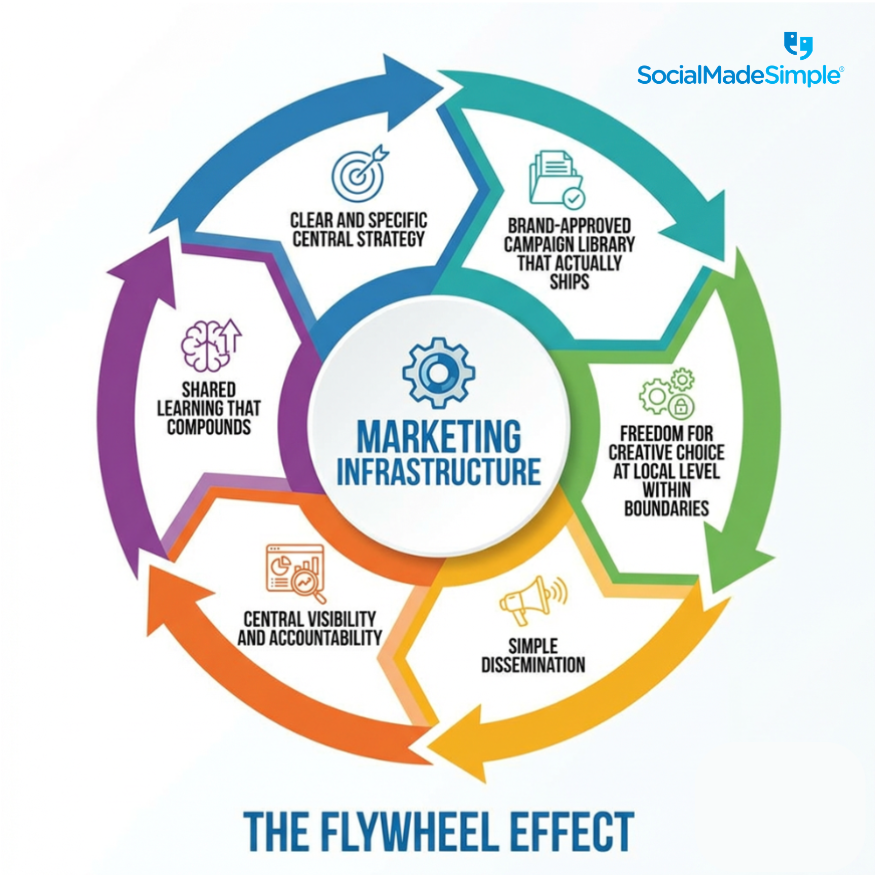
Successful franchises know marketing isn’t the end; it’s the means. The components of a successful operating system include:
1) Clear and specific central strategy
Awareness isn’t action, it begs the question, “so what?” Simply being aware of your brand doesn’t compel customers to do business with you.
Ask yourself:
- Who are we trying to reach this quarter?
- What are we offering? Why is this offer the best strategy?
- What claims can we make, and what are off-limits?
- What are the 3–5 approved angles the network should use?
2) A brand-approved campaign library that actually ships
Move beyond a PDF brand guide that your network won’t read. Provide them with approved, copy-and-paste-ready:
- headlines and copy blocks
- image frameworks and creative templates
- targeting rules and guardrails
- variations of the offer
- An approval process for version control (so “random Canva graphics” don’t become the default)
3) Freedom for creative choice at the local level within the boundaries set by HQ
Provide franchisees autonomy without letting them break the system.
- Autonomy: local city name, local phone number, local staff photo (if approved), local scheduling link, approved offers
- Boundaries: new claims, new offers, off-brand colors/fonts, “creative rewrites” of core messaging
4) Simple dissemination
If it takes 3 weeks to launch and implement your strategy, the franchisees will go rogue. Get ahead of the chaos with a brand-safe, quick-launch option.
5) Central visibility and accountability
At any given moment, HQ should be able to answer:
- What is running in each market, and which versions
- How much is being spent
- If the campaigns are successful, and why or why not
- If and where there is a drift from the set standards
6) Shared learning that compounds
The ultimate goal of franchise marketing is to easily compile data from your franchisees, translate it into a clear action plan, and implement it seamlessly.
Don’t waste your potential ROI by letting the success of one location’s marketing strategy sit stagnant. If one message works, it needs to become part of the overall strategy to ensure the entire network succeeds.
Your franchise won’t succeed because you have the best ads, but because you have the best learning machine.
Make AI work for you
AI doesn’t have to be a threat, as long as you give it a job description. Within your marketing system, AI can:
- Generate variations of graphics or copy within the boundaries set by HQ
- Localize creative (city, offer window, local details, etc.) without drifting from the brand’s voice
- Summarize performance patterns across all locations (or a sampling of locations, such as a specific region, state, or timezone)
- Highlight what’s working and flagging what isn’t
- Reduce the burden on HQ teams supporting hundreds of unique operators
AI is the gas in the car, but you’re behind the wheel. That’s the difference between AI chaos and AI leverage.
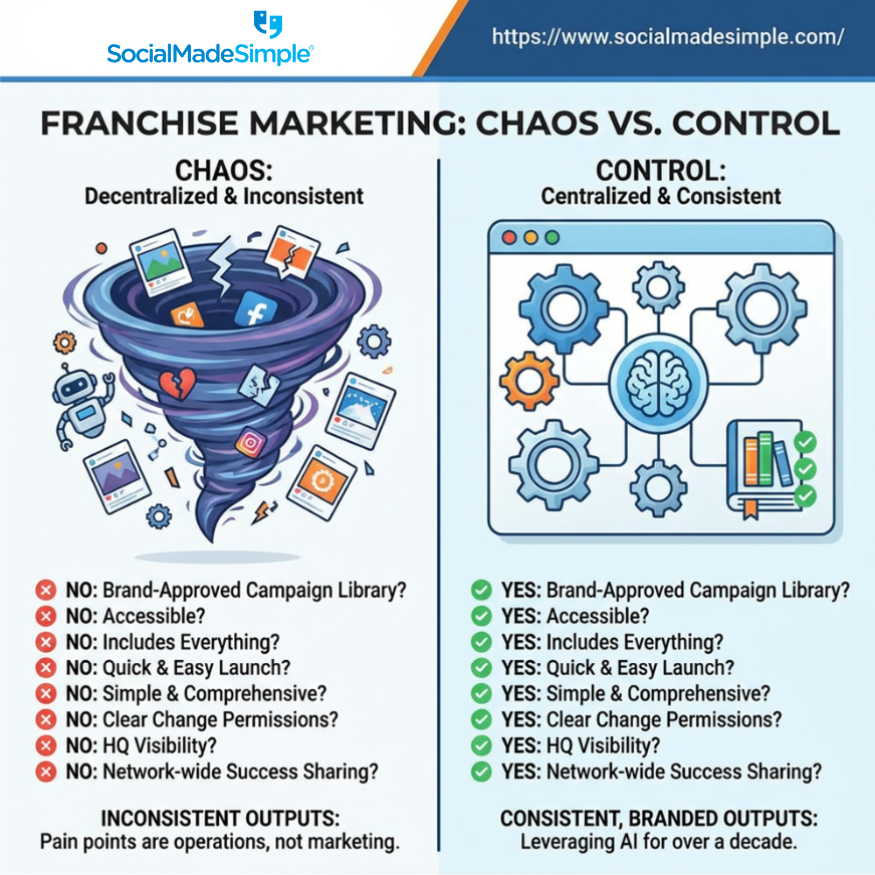
In short, do you have control, or just guidelines?
- Does the company have a real brand-approved campaign library that gets used? Is it accessible? Does it include everything a location needs to implement your strategy?
- Can franchisees launch quickly and easily? Is what we provide simple enough to be useful but comprehensive enough to cover all the bases?
- Is it crystal clear what locations can and can’t change?
- Can HQ see what’s live across the network without having to check each location?
- Are the successes and improvements available to the whole network, or do the insights stay local?
If you can’t say “yes” to these without certainty, then your pain points aren’t because of your marketing but your operations.
Lucky for you, SocialMadeSimple has been leveraging AI in franchise marketing for over a decade, long before the current trends.
Don’t let the speed of AI outpace your ability to lead; it’s time to move from static guidelines to an active marketing engine that protects your equity at scale. To see how this works in practice, join our 60-day franchise pilot program and discover how to deploy brand-safe, AI-enhanced campaigns across your entire network without sacrificing control.

Our aim is to bring our blend of social advertising and marketing automation to businesses across the country.
Delivering success for global brands across all industries

5.3M+
Ad Views

40%
Lead Conversion Rate

1.5M+
Leads Generated